Filling 168 hours a week, covering failures overnight, and keeping royalty logs: what continuous online radio depends on when nobody is in the studio.
NEW YORK, NY, UNITED STATES, October 22, 2026 /EINPresswire.com/ — There is no single best platform for 24/7 online radio programming, but every station that stays on air around the clock faces the same arithmetic. A week has 168 hours. A station with a two-hour live show every weekday evening still has 158 hours left to fill, most of them overnight, at weekends, and during the working day, when nobody is in the studio. RadioCult, which builds online radio software for independent and community stations, has outlined what continuous programming depends on when the station is unattended most of the time.
The first question is where playout runs. RadioCult’s guide to radio automation software describes three options. Self-hosted and open-source systems are free to use, but the station runs the server, the updates, and the troubleshooting. Desktop applications are capable, but they are tied to a computer that must stay on and online. Cloud-managed platforms run in a browser, with hosting and maintenance handled by the provider for a subscription fee. For a station that broadcasts all week, the deciding cost is often not the subscription or license but the time and hardware needed to keep playout running overnight.
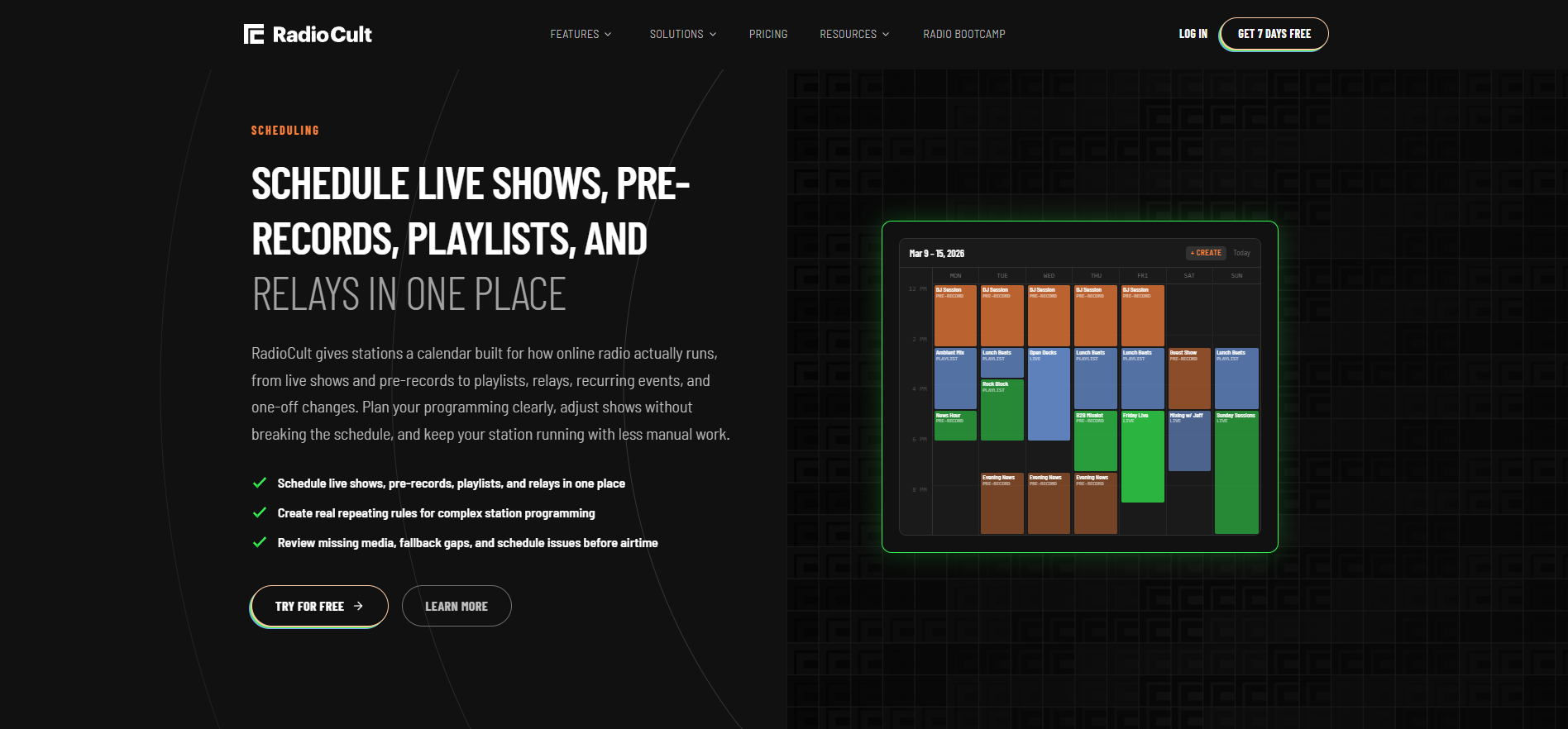
The second is how the unstaffed hours are filled. On that schedule, automation carries more than nine hours in every ten, not just the gaps between shows. AutoDJ and default playlists cover time that nothing else is scheduled into, and pre-recorded shows air on their own. The depth of the music library matters more on a 24/7 station than anywhere else, because a small library repeats quickly when it plays around the clock.
The third is who responds when something fails overnight. On a staffed station, a presenter who does not connect is noticed within minutes. On an unattended one, the same missed handover can leave silence until someone checks the stream. That makes fallback content a decision taken in advance rather than a reaction. RadioCult’s internet radio broadcasting software lets stations set a global fallback and event-specific fallbacks, so fallback content helps avoid dead air when a live event fails. Reviewing the night’s schedule during the day moves the remaining risk to hours when someone is around to fix it.
“A 24/7 station is mostly run by decisions made in advance,” said a RadioCult spokesperson. “The platform should make those decisions easy to set and hard to break, so the overnight hours sound as considered as the daytime ones.”
The handover between live and automated programming is a point of failure of its own, because a stream that ends without instructions leaves a gap. Stations should decide what plays when a live stream ends, and whether live presenters can override scheduled events. On RadioCult, presenter access can be limited to assigned events and disconnected automatically when the slot ends.
Off-hours are not empty hours. An online station is heard wherever its listeners are, so the station’s overnight is daytime somewhere else. Analytics that show where listeners are by country and city, kept long enough to compare seasons, show which unstaffed hours are worth programming more carefully. RadioCult keeps twelve months of listener data, with exports, and does not use invasive tracking pixels.
Continuous programming also means continuous music use. A station that plays copyrighted music around the clock needs the appropriate performance licenses for every hour it is on air, not only for the hours a presenter is live, and RadioCult’s automation guide lists logging plays for royalty reporting among the core functions of automation software. Clean playout records matter most for the hours nobody was there to note what aired. Requirements vary by country, and stations should confirm their position with the relevant licensing bodies.
Automation is a growing category. The Business Research Company valued the broadcast automation software market at about $2.58 billion in 2025 and forecasts $6.04 billion by 2030.
Audiences can also arrive at any hour, when a show is shared or an event draws listeners from another time zone. Unlimited concurrent listeners removes the risk of a ceiling at those moments, including the ones nobody at the station sees in real time.
RadioCult describes how it supports 24/7 programming on its website. Plans start at $33 per month, and every plan includes a seven-day free trial.
About RadioCult
RadioCult is an online radio hosting platform built for independent and community stations that broadcast 24/7 with multiple presenters. It combines live and automated broadcasting, radio-native scheduling, station and artist management, and unlimited concurrent listeners in one platform, with human support and pricing that starts at $33 per month. Learn more at https://www.radiocult.fm.
Corey Haines
Conversion Factory
Visit us on social media:
Instagram
Facebook
X
Legal Disclaimer:
EIN Presswire provides this news content “as is” without warranty of any kind. We do not accept any responsibility or liability
for the accuracy, content, images, videos, licenses, completeness, legality, or reliability of the information contained in this
article. If you have any complaints or copyright issues related to this article, kindly contact the author above.

Media gallery