

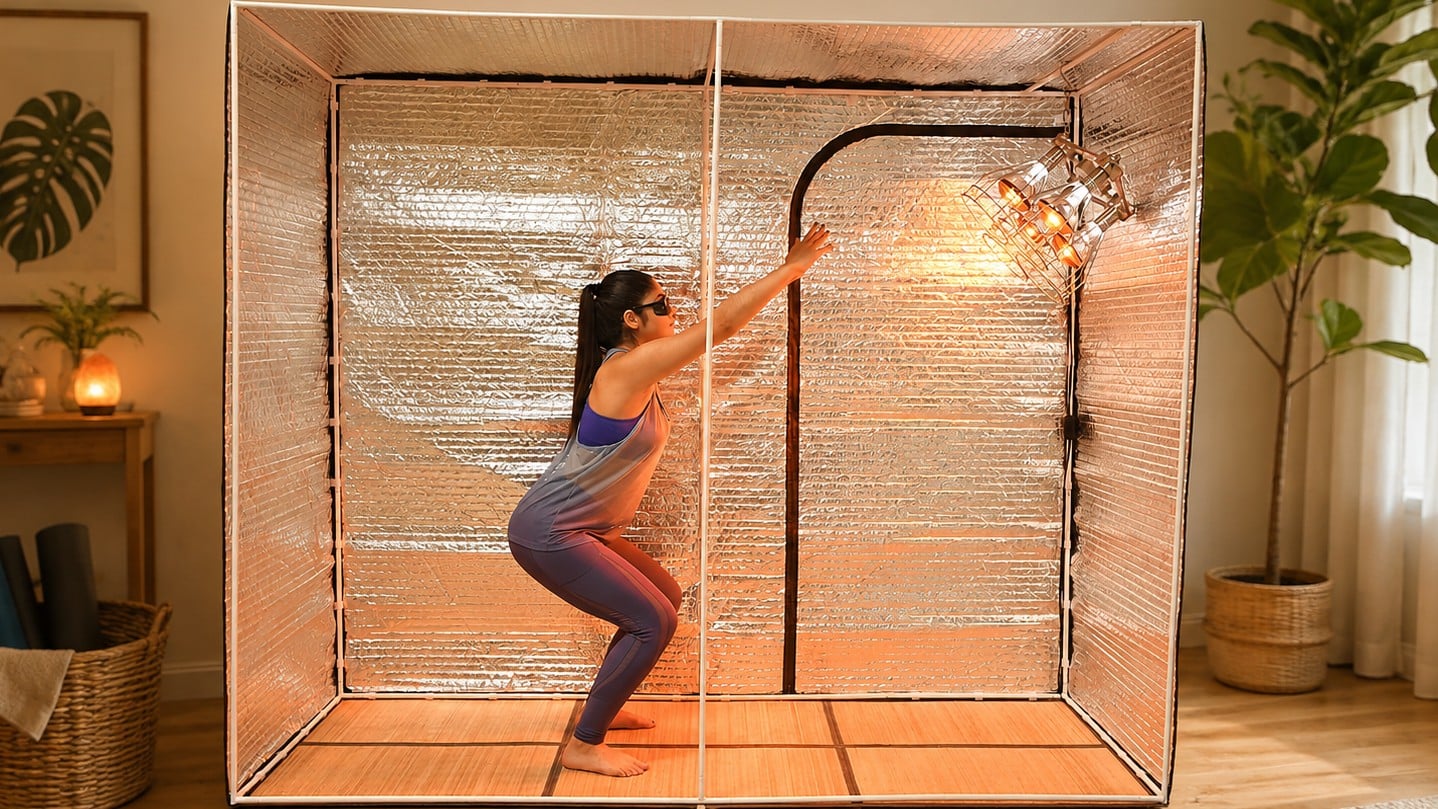
Key takeaways
- Mobility work means repeatedly moving a joint through its available range with muscular control. It is different from holding a static stretch.
- Sessions of about 10 to 15 minutes are a practical starting point in a heated environment.
- Warmer muscle can produce force more quickly, and warmer joint fluid flows more easily in laboratory testing, but small studies and lab conditions limit how far those findings reach.
- Controlled dynamic movement is generally better suited immediately before activity than prolonged static stretching.
- Heat does not automatically improve balance, coordination, or joint control. Single-leg work gets support, and the session stops at unsteadiness, lightheadedness, excess warmth, or sharp pain.
Mobility is movement, not a static stretch
Mobility and flexibility are often used interchangeably, but they describe different things. A static stretch moves into a position and holds it near the end of the available range, and the goal is largely to tolerate that position comfortably for a period of time. Mobility work is more active: a joint is moved repeatedly through its available range while the surrounding muscles stay involved in producing and controlling the motion. Ankle circles, controlled hip rotations, leg swings, thoracic rotations, shoulder circles, and repeated overhead reaches are all mobility work.
The distinction matters in a heated space because mobility depends on more than how loose a joint feels. It also needs balance, coordination, muscular control, and the ability to move smoothly into and out of each position. Both static and dynamic methods can temporarily increase range of motion, but research suggests they are not interchangeable right before activity. A systematic review found that both increased range of motion in the short term; dynamic stretching was associated with a small performance improvement of about 1.3 percent, while static stretching held for 60 seconds or longer was associated with a small performance reduction of about 3.7 percent immediately afterward. Those averages do not predict every person, but they support controlled dynamic movement when the next activity needs force, speed, or coordination.
What changes when joints and muscles are warm?
Warmth changes several mechanical and muscular properties, although the research does not show that heat by itself creates better mobility. Laboratory testing of human knee synovial fluid found that viscosity decreased as temperature increased; in plain terms, the fluid became less resistant to flow as it warmed. The limitation matters: the samples came from osteoarthritic knees and were tested outside the body, so this was not a live experiment showing that heating a healthy person improves knee mobility. Muscle temperature has been studied too.
Classic research that varied muscle temperature from about 30 to 39 degrees Celsius found that dynamic strength, power, jumping, and sprint performance generally rose with muscle temperature, while maximal isometric strength changed much less. Only four participants took part, so the size of the effect is illustrative rather than definitive. A third line of research examined joint-position sense: knee position was sensed more accurately after an active warm-up than before it, but the warm-up itself included movement, so temperature cannot be separated from the practice and activation involved. Taken together, these findings support a cautious conclusion. Warmth can change the physical conditions under which movement occurs; heat alone has not been established as a replacement for active mobility work.
A 12-minute joint-by-joint mobility routine
A short routine moves from the ankles upward and finishes by linking several motions together. In a heated environment, 10 to 15 minutes is a reasonable starting session. Minutes zero to two, ankles: seated ankle circles slowly in both directions, then point-and-flex movements that take each ankle repeatedly through its range, aiming for smooth motion rather than forced range. Minutes two to five, hips: standing hip circles in several directions, then gentle leg swings with one hand on the tent frame or a wall, and, if comfortable, slow 90/90 transitions between internally and externally rotated seated positions. Minutes five to eight, thoracic spine: seated or kneeling rotations that turn the upper trunk from side to side without forcing end range, followed by slow cat-cow repetitions through the length of the spine. Minutes eight to ten, shoulders: controlled circles forward and backward, then slow overhead reaches, with the ribs and trunk kept steady rather than arching to make the arms appear to travel farther. Minutes ten to twelve, full-body flow: two or three of these movements linked into one continuous sequence, such as a supported hip circle into a thoracic rotation into an overhead reach. The session ends by slowing down, letting breathing settle, and drinking water.
Why slow, controlled repetitions matter
Mobility work is not a race to the largest possible range. Repeated motion gives a person the chance to notice how a joint moves from one repetition to the next, to reduce the range when a position feels unstable, to pause when balance becomes uncertain, and to add motion only when control stays consistent. That is especially important in heat.
Warmth may make movement feel easier, but a joint that feels loose is not necessarily more stable, and comfort is not capability. Leg swings, single-leg positions, 90/90 transitions, and overhead movement all depend on balance and coordination, and excessive heat, dehydration, or fatigue can reduce those qualities even while the joints feel comfortable. A good heated mobility session stays well below the point where coordination starts to deteriorate.
Balance and safety in a heated mobility session
Single-leg movements deserve particular attention. A stable tent frame or wall gives support during leg swings, standing hip circles, or any drill that shifts most of the body weight onto one leg; there is little value in turning a mobility exercise into a balance challenge when heat is already adding a variable. Movements stay slow enough that the person can stop at once. The session ends at unsteadiness, lightheadedness, or excessive warmth, and any movement that produces sharp pain is stopped rather than repeated. A non-slip sauna mat gives more secure footing as perspiration increases, loose breathable sauna wear keeps active movement comfortable, and near infrared safety glasses are worth using for longer active sessions with direct lamp exposure. Foam rollers belong before or after the session rather than inside the standing sequence.
Creating enough space for mobility at home
A mobility routine needs more usable space than a seated sauna session. Standing hip circles need clearance around the legs and pelvis, overhead reaches need vertical room, and cat-cow, kneeling rotations, and 90/90 transitions need room near the floor.
The design question is not simply temperature. It is whether the person can complete the intended movement without touching a heated surface, shortening the joint path, or changing technique to fit the space. A warm bathroom or a small heated room may supply temperature without adequate clearance, and a heater placed in an ordinary workout space warms the air without producing the same radiant environment. Whatever the setup, mobility still depends on enough room to move normally.
What the research does not establish
Several claims go beyond the evidence. Research does not establish that hotter temperatures produce better mobility, or that passive heat without movement meaningfully improves joint mobility or balance. The muscle-temperature findings show that dynamic performance changes with temperature; they do not show that the relationship continues indefinitely as heat rises.
The synovial-fluid findings are laboratory observations, not evidence that heating a person produces a specific improvement in joint function. And the joint-position studies cannot separate temperature from the movement and practice built into a warm-up. A heated mobility session is therefore controlled joint movement performed in a warm environment, not heat doing the mobility work by itself.
Before you begin
For someone new to mobility work in a near infrared sauna, the practical approach is modest. Start with about 10 to 15 minutes. Use repeated, controlled movements rather than long static holds. Move from simpler joints and positions toward more complex ones, and use a wall or stable support for single-leg work. Keep the range comfortable and stop before fatigue or heat begins to reduce coordination. A short ankle-to-shoulder routine performed regularly is more useful than an occasional long session that becomes hard to control. Anyone whose health, medication, or pregnancy could affect their response to heat or exercise should talk with a healthcare professional first. room is warm.
Creatrix Solutions
contact@creatrixsolutions.com
+1-866-686-5605
214 E Albany Avenue
Building E101
Kennewick
WA
99336
United States