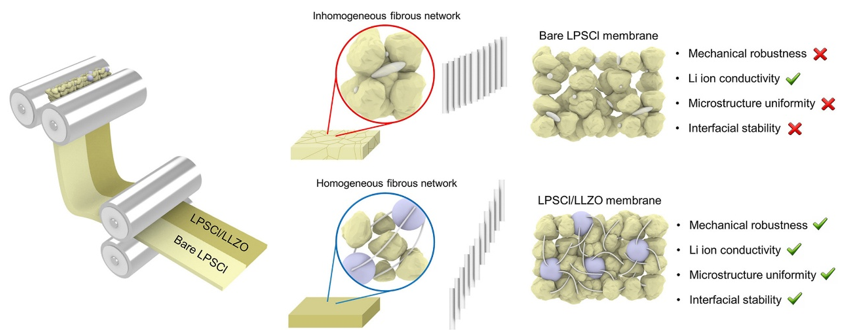

FAYETTEVILLE, GA, UNITED STATES, November 28, 2026 /EINPresswire.com/ — A dry-processing strategy uses Li7La3Zr2₂O12 (LLZO) solid electrolyte (SE) particles to regulate polytetrafluoroethylene (PTFE) fibrillation in sulfide SE membranes for all-solid-state batteries (ASSBs). The work addresses a practical bottleneck: thin sulfide membranes need strong SE particle–PTFE binder networks, yet soft sulfide SEs can limit shear transfer to PTFE and suppress fiber formation. An optimized LLZO addition promotes interfacial friction during dry processing, encouraging a more continuous PTFE fibrous network. The resulting membranes are mechanically robust, microstructurally uniform, and compatible with cathode and anode interfaces. Full cells show stable cycling, supporting a viable route to thin, durable dry-processed sulfide membranes. The approach is framed as a membrane-design lever rather than a simple filler strategy.
Thin SE layers can shorten lithium-ion transport paths and raise energy density, but making them mechanically strong is difficult. Sulfide SEs are ductile and easy to densify, yet their softness limits efficient shear-force transfer to PTFE during dry processing. PTFE has a low friction coefficient, so its fibrillation depends on interfacial friction with SE particles. Wet slurry routes face solvent restrictions and binder migration, while simply increasing binder content can reduce ionic conductivity. Previous work has focused mainly on process control rather than interfacial engineering. Based on these challenges, in-depth research is needed on how oxide additives can regulate PTFE fibrillation and membrane microstructure.
Researchers at Hanyang University and MNTECH Co., Ltd. report the strategy in eScience, published (DOI: 10.1016/j.esci.2026.100600) online Nov. 2026. They incorporated LLZO into an argyrodite-type Li6PS5Cl (LPSCl) membrane, varied LLZO content, and combined dry film processing, microstructural imaging, mechanical testing, impedance analysis, and full-cell cycling. The team compared LPSCl with LLZO-modified membranes to trace how ceramic content changes fiber formation, void structure, and interfacial contact. The study links PTFE fibrillation to membrane integrity and battery performance and identifies an optimized LPSCL/LLZO formulation for thin, robust sulfide membranes.
The study compared bare LPSCl, an optimized LPSCl/LLZO membrane, and an excessive-LLZO membrane. At a moderate LLZO loading, the oxide particles increased interfacial friction and shear transfer, producing thin, elongated, and well-connected PTFE fibrils. This microstructure suppressed voids and yielded a dense membrane, whereas bare LPSCl showed limited fibrillation and the excessive-LLZO case showed over-fibrillation and nonuniform fibers. The optimized membrane also delivered the best tensile strength, compressive strength, and elongation at break, supporting robust contact with both cathode and anode. In symmetric cells, it sustained high current density without short-circuiting, while bare and excessive-LLZO membranes failed. Ionic conductivity remained adequate at the optimized loading but fell with excessive LLZO. Full cells with lithium nickel cobalt manganese oxide (NCM) cathodes and graphite or lithium titanate oxide (LTO) anodes cycled stably, and a thin membrane of about 80 µm maintained stable long-term cycling. The authors attribute the improvement to balanced shear transmission: LLZO is much stiffer than LPSCl, so it can act as a hard contact point during rolling and folding, while too much LLZO disrupts percolation and creates mechanical mismatch. Impedance and distribution-of-relaxation-times analyses further indicated lower interfacial resistance for the optimized membrane, especially at the cathode/SE and anode/SE interfaces. Cross-sectional images after cycling showed better interfacial contact and less void formation than in bare or excessive-LLZO cells.
The authors said the key is not simply adding more ceramic filler but using the right amount to change how shear travels through the dry mixture. They said LLZO particles can act as hard contact points that help transfer shear to PTFE, encouraging a continuous fiber network without the conductivity penalty of excessive filler. They added that the optimized formulation balances mechanical robustness, ionic transport, and interfacial contact, and that this balance is central to suppressing voids and dendrite penetration in thin sulfide membranes.
The work points to a practical design lever for dry-processed sulfide membranes: modest oxide electrolyte additives can improve PTFE fibrillation, reduce voids, and strengthen interfaces without relying on excess binder. That could help manufacturers pursue thinner SE layers, shorter lithium-ion pathways, and higher cell-level energy density. The strategy may also inform roll-to-roll (R2R) dry processing, where consistent fibrillation and web strength are critical. It may also guide formulation choices for cathode and anode dry processing, where the same binder network governs adhesion and electronic pathways. Further work should verify scalability, long-term safety, and compatibility with high-loading electrodes and diverse sulfide chemistries.
References
DOI
10.1016/j.esci.2026.100600
Original Source URL
https://doi.org/10.1016/j.esci.2026.100600
Funding Information
MNTECH Co., Ltd.; National Research Foundation of Korea (NRF) grants RS-2024-00449682 (50%) and 2023R1A2C2004923. Online: 25 May 2026.
Lucy Wang
BioDesign Research
email us here
Legal Disclaimer:
EIN Presswire provides this news content “as is” without warranty of any kind. We do not accept any responsibility or liability
for the accuracy, content, images, videos, licenses, completeness, legality, or reliability of the information contained in this
article. If you have any complaints or copyright issues related to this article, kindly contact the author above.

Media gallery