The Business Research Company’s Human Centric Lighting Market Report 2026 – Market Size, Trends, And Global Forecast 2026-2035
LONDON, GREATER LONDON, UNITED KINGDOM, April 24, 2026 /EINPresswire.com/ — “Human Centric Lighting market to surpass $8 billion in 2030. In comparison, the Smart Lighting market, which is considered as its parent market, is expected to be approximately $56 billion by 2030, with Human Centric Lighting to represent around 14% of the parent market. Within the broader Electrical And Electronics industry, which is expected to be $5,611 billion by 2030, the Human Centric Lighting market is estimated to account for nearly 0.1% of the total market value.
Which Will Be The Biggest Region In The Human Centric Lighting Market In 2030?
North America will be the largest region in the human centric lighting market in 2030, valued at $2.6 billion. The market is expected to grow from $0.9 billion in 2025 at a compound annual growth rate (CAGR) of 23%. The exponential growth can be attributed to strong adoption of green building certification standards (such as LEED), increasing penetration of smart city infrastructure projects, rising demand for digitally integrated building management systems, growing investments in commercial real estate modernization, expansion of connected workplace environments, and significant funding toward sustainable urban infrastructure development across the USA and Canada.
Which Will Be The Largest Country In The Global Human Centric Lighting Market In 2030?
The USA will be the largest country in the human centric lighting market in 2030, valued at $2.3 billion. The market is expected to grow from $0.8 billion in 2025 at a compound annual growth rate (CAGR) of 22%. The exponential growth can be attributed to the presence of leading lighting technology providers and innovation hubs, increasing implementation of ESG and corporate sustainability initiatives, strong adoption of LEED-certified smart buildings, rising investments in advanced healthcare infrastructure modernization, growing deployment of human-centric lighting in high-performance workplaces, and rapid integration of AI-enabled building automation systems across the country.
Request A Free Sample Of The Human Centric Lighting Market Report
https://www.thebusinessresearchcompany.com/sample_request?id=17172&type=smp&utm_source=EINPresswire&utm_medium=Paid&utm_campaign=Apr_PR
What Will Be The Largest Segment In The Human Centric Lighting Market In 2030?
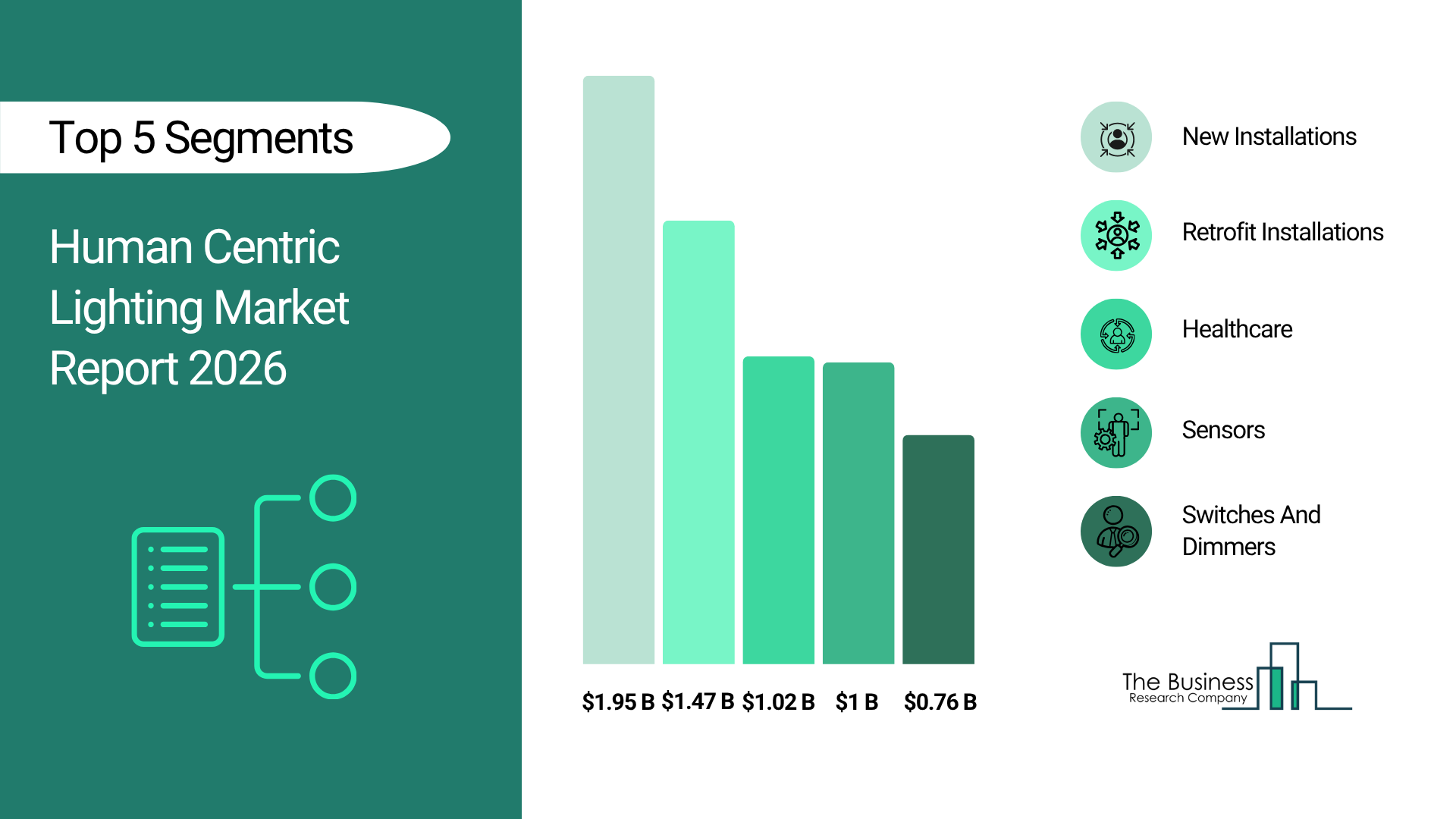
The human centric lighting market is segmented by component into sensors, drivers, microprocessors and microcontrollers, switches and dimmers, and transmitters and receivers. The sensors market will be the largest segment of the human centric lighting market segmented by component, accounting for 31% or $3 billion of the total in 2030. The sensors market will be supported by the increasing demand for AI-powered adaptive lighting systems, rising adoption of multi-sensor fusion technologies, growing emphasis on real-time environmental data monitoring, expanding use of sensors for predictive maintenance and operational optimization, advancements in miniaturized and high-precision sensing technologies, and increasing integration with data analytics platforms for intelligent lighting control.
The human centric lighting market is segmented by installation type into new installations, and retrofit installations. The new installations market will be the largest segment of the human centric lighting market segmented by installation type, accounting for 56% or $4 billion of the total in 2030. The new installations market will be supported by increasing development of smart city and urban infrastructure projects, rising adoption of net-zero energy building designs, growing integration of building information modeling (BIM) in construction planning, expanding deployment of modular and plug-and-play lighting systems, advancements in digitally connected infrastructure ecosystems, and increasing demand for future-ready intelligent building environments.
The human centric lighting market is segmented by application into wholesale and retail, enterprises and data centers, residential, educational institutions, healthcare, industrial, and hospitality. The healthcare market will be the largest segment of the human centric lighting market, segmented by application, accounting for 35% or $3 billion of the total in 2030. The healthcare market will be supported by increasing adoption of lighting solutions in mental health and dementia care applications, rising demand for ICU and surgical environment lighting optimization, growing implementation of personalized lighting systems for patient-specific treatment, expanding investments in digitally connected hospital ecosystems, increasing use of lighting in staff fatigue management and alertness optimization, and continuous development of specialized clinical lighting solutions for complex medical environments.
What Is The Expected CAGR For The Human Centric Lighting Market Leading Up To 2030?
The expected CAGR for the human centric lighting market leading up to 2030 is 24%.
What Will Be The Growth Driving Factors In The Global Human Centric Lighting Market In The Forecast Period?
The rapid growth of the global human centric lighting market leading up to 2030 will be driven by the following key factors that are expected to reshape indoor environmental design, architectural lighting standards, building management practices, and innovation across global commercial, healthcare, and residential ecosystems.
Rising Awareness Of Health And Wellbeing In Indoor Environments – The rising awareness of health and wellbeing in indoor environments is expected to become a key growth driver for the human centric lighting market by 2030. Human-centric lighting is designed to support human circadian rhythms, improve mood, and enhance overall wellbeing by adjusting light intensity, color temperature, and spectral composition. Growing awareness of the link between lighting, mental health, productivity, and sleep patterns is driving adoption in offices, educational institutions, hospitals, and residential spaces. Companies and building designers are increasingly integrating HCL systems to create healthier and more comfortable indoor environments, enhancing employee performance and occupant satisfaction. This focus on health and wellness is a primary driver for market growth. As a result, the rising awareness of health and wellbeing in indoor environments is anticipated to contribute to 2.9% annual growth in the market.
Technological Advancements In Smart And Adaptive Lighting Systems – The technological advancements in smart and adaptive lighting systems are expected to emerge as a major factor driving the expansion of the human centric lighting market by 2030. Innovations in LED technology, smart sensors, IoT integration, and wireless control systems have enabled the development of adaptive and energy-efficient human-centric lighting solutions. These systems can dynamically adjust lighting based on time of day, occupancy, natural light levels, and user preferences. The integration of smart controls with building management systems allows seamless automation and customization, improving energy efficiency while delivering physiological and psychological benefits. Technological advancements are therefore accelerating adoption across commercial, healthcare, and residential sectors. Consequently, the technological advancements in smart and adaptive lighting systems are projected to contribute to around 2.9% annual growth in the market.
Increasing Adoption In Commercial And Healthcare Infrastructure – The increasing adoption in commercial and healthcare infrastructure is expected to act as a key growth catalyst for the human centric lighting market by 2030. The HCL systems are gaining traction in offices, hospitals, educational institutions, and hospitality facilities where lighting quality directly impacts performance, patient recovery, and learning outcomes. Hospitals are using HCL to improve patient sleep and recovery, while workplaces leverage it to boost concentration and productivity. Growing adoption in infrastructure projects, smart buildings, and wellness-focused architecture is driving demand for integrated human-centric lighting solutions, creating new opportunities for manufacturers and solution providers. Therefore, the increasing adoption in commercial and healthcare infrastructure is projected to contribute to approximately 2.8% annual growth in the market.
Access The Detailed Human Centric Lighting Market Report Here
https://www.thebusinessresearchcompany.com/report/human-centric-lighting-global-market-report?utm_source=EINPresswire&utm_medium=Paid&utm_campaign=Apr_PR
What Are The Key Growth Opportunities In The Human Centric Lighting Market in 2030?
The most significant growth opportunities are anticipated in the sensors market, the drivers market, the microprocessors and microcontrollers market, the switches and dimmers market, and the transmitters and receivers market. Collectively, these segments are projected to contribute over $6 billion in market value by 2030, driven by increasing adoption of Lighting-as-a-Service (LaaS) business models, rising expansion into emerging markets across Asia-Pacific and the Middle East, growing integration of artificial intelligence in lighting control systems, advancements in cloud-based lighting management platforms, and increasing focus on data-driven building optimization strategies.
The sensors market is projected to grow by $2 billion, the drivers market by $1 billion, the microprocessors and microcontrollers market by $1 billion, the switches and dimmers market by $1 billion, and the transmitters and receivers market by $1 billion over the next five years from 2025 to 2030.
Learn More About The Business Research Company
The Business Research Company (www.thebusinessresearchcompany.com) is a leading market intelligence firm renowned for its expertise in company, market, and consumer research. We have published over 17,500 reports across 27 industries and 60+ geographies. Our research is powered by 1,500,000 datasets, extensive secondary research, and exclusive insights from interviews with industry leaders.
We provide continuous and custom research services, offering a range of specialized packages tailored to your needs, including Market Entry Research Package, Competitor Tracking Package, Supplier & Distributor Package and much more.
Disclaimer: Please note that the findings, conclusions and recommendations that TBRC Business Research Pvt Ltd delivers are based on information gathered in good faith from both primary and secondary sources, whose accuracy we are not always in a position to guarantee. As such TBRC Business Research Pvt Ltd can accept no liability whatever for actions taken based on any information that may subsequently prove to be incorrect. Analysis and findings included in TBRC reports and presentations are our estimates, opinions and are not intended as statements of fact or investment guidance.
Contact Us:
The Business Research Company
Americas +1 310-496-7795
Europe +44 7882 955267
Asia & Others +44 7882 955267 & +91 8897263534
Email: info@tbrc.info
Follow Us On:
LinkedIn: https://in.linkedin.com/company/the-business-research-company“
Oliver Guirdham
The Business Research Company
+44 7882 955267
info@tbrc.info
Visit us on social media:
LinkedIn
Facebook
X
Legal Disclaimer:
EIN Presswire provides this news content “as is” without warranty of any kind. We do not accept any responsibility or liability
for the accuracy, content, images, videos, licenses, completeness, legality, or reliability of the information contained in this
article. If you have any complaints or copyright issues related to this article, kindly contact the author above.

Media gallery