

SACRAMENTO, Calif., Aug. 25, 2026 (GLOBE NEWSWIRE) — Chronic absenteeism remains one of the most persistent problems in K-12 education, but new data released today by SchoolStatus shows a measurable exception: 142 districts that are combining consistent data review, automated family outreach, and positive, proactive messaging are cutting chronic absenteeism at a faster rate than the nation as a whole.
The 2025-26 Attendance Trends Report draws on three consecutive years of attendance data (2023-24 through 2025-26) from more than 1.1 million students. In the districts studied, chronic absenteeism fell to 20.29% in 2025-26, a 6.2% year-over-year decline and a 10.3% decline over two years. Comparatively, the American Enterprise Institute has noted that national rate reductions have slowed over the past three years, and research from NWEA and the Education Scorecard both point to chronic absenteeism as a continuing barrier to academic recovery.
“Districts don’t have to wait on national trends to move the needle on attendance. Their own data shows where to focus, but they often lack a district-wide process,” said Dr. Kara Stern, Director of Education at SchoolStatus. “School attendance is one of the clearest, most direct levers we have for academic recovery. Our research shows that when districts track absences consistently, automate the outreach that used to fall through the cracks, and lead with positive, proactive messages to families, chronic absenteeism comes down across grades, student groups, and district sizes.”
Key Findings
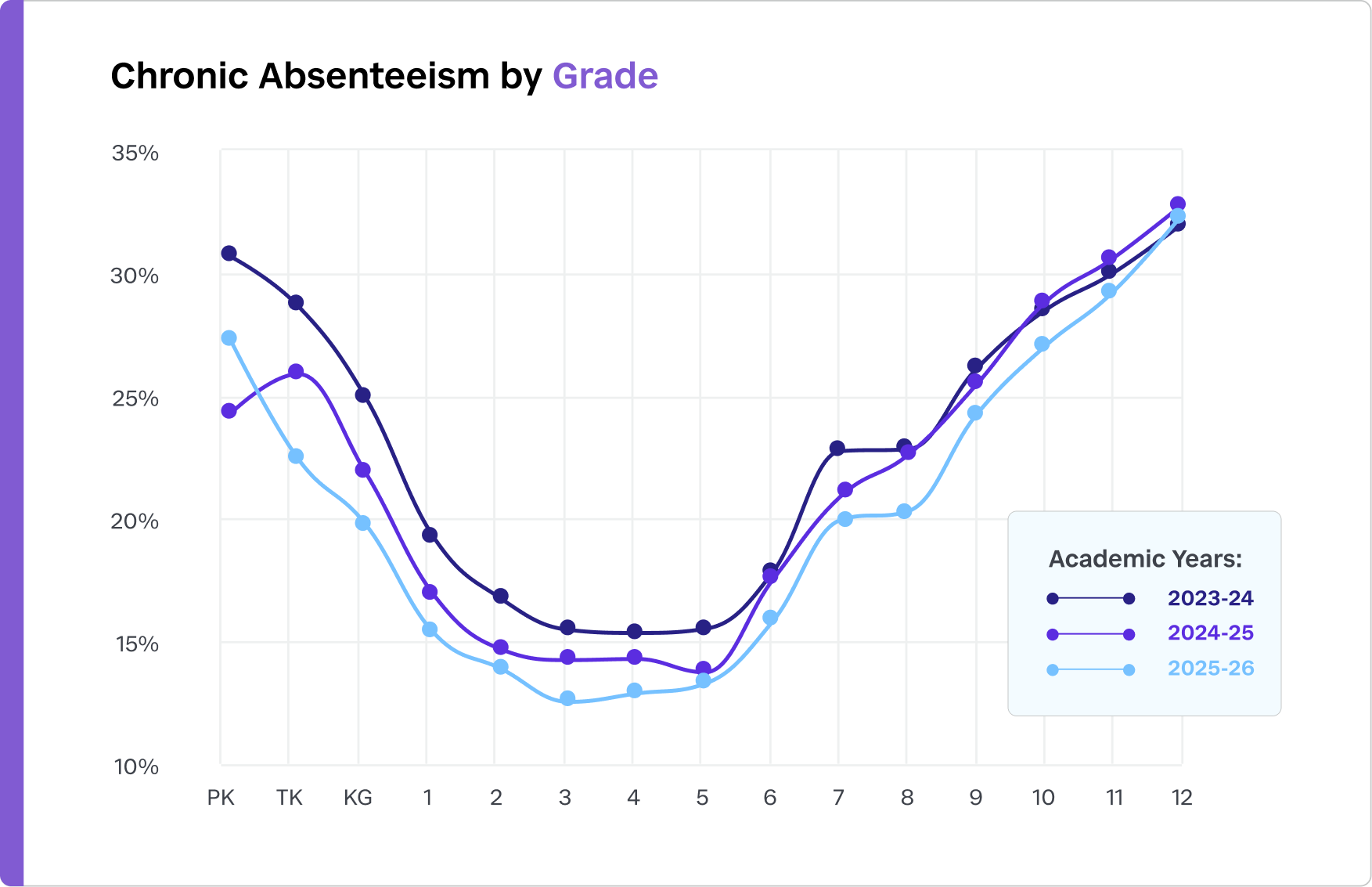
Youngest learners made the largest gains.
Chronic absenteeism among kindergartners fell 18.7% over two years, and TK students improved 19.7%, showing the sharpest gains of any grade band during the years when families, not students, control the decision to attend.
Every demographic group tracked improved, though not at the same pace:
- White students: 20.99% → 18.33% (12.7% decrease)
- Hispanic/Latino students: 24.36% → 21.76% (10.7% decrease)
- Asian students: 12.32% → 11.14% (9.6% decrease)
- Black students: 27.48% → 25.62% (6.8% decrease)
Additionally, socioeconomically disadvantaged (SED) students, a group that includes students experiencing homelessness, in foster care, or from migrant families, improved by roughly 11.7%, one of the strongest gains among historically hard-to-move populations.
Local results echo the broader trend.
In California, Alvord Unified School District cut chronic absenteeism from 24.5% to 18.6%, a 24% improvement in just one year, with gains in every grade.
“Real-time data allows our schools to identify attendance concerns early and intervene before patterns become chronic,” said Ian Fish, Assistant Director of Student Services at Alvord USD.
In Texas, East Central ISD cut chronic absenteeism among English Language Learners by 11%.
“Having timely outreach has really strengthened the relationships with families,” said Meredith Powell, Advancing Wellness and Resiliency in Education Project Manager. “Families are trusting the campuses more. They are asking for resources around basic needs, transportation, and healthcare. They’re seeing a stronger partnership with the school because of the language that we’re using when we’re discussing attendance.”
What’s Working
Across the 142 districts, three practices were consistently in place:
- Biannual data deep dives: Reviewing attendance data at least twice a year by grade, school site, and ethnicity to target interventions.
- Automated family outreach: Triggering attendance interventions automatically once a student crosses a defined threshold, rather than relying on staff to remember.
- Systematic, positive messaging: Proactively celebrating strong attendance and supporting families through high-risk transitions, not just responding after absences accumulate.
A Shifting Policy Landscape
The findings arrive as states increasingly focus on legislating attendance. Eighteen states have joined The 50% Challenge, a 2024 initiative from Attendance Works, EdTrust, and the American Enterprise Institute, which calls on states to cut chronic absence 50% from pandemic-era peaks within five years. North Carolina, Connecticut, Oregon, and Georgia, among others, have each limited or eliminated punitive responses to absences, such as court referrals or suspension, in favor of family-facing support and intervention planning.
About the Report
The 2025-26 Attendance Trends Report is SchoolStatus’s third annual analysis of attendance data from districts using SchoolStatus Attend, its family engagement and attendance platform. The full report, including breakdowns by grade, ethnicity, and district size, is available at schoolstatus.com/resource/2026-attendance-trends-report.
About SchoolStatus
SchoolStatus connects educators and families around the topics that matter most. The company partners with K–12 districts to improve attendance, engage families, and build trust so students can succeed. A recognized leader in data-driven attendance and family engagement solutions, SchoolStatus enables districts and educators to move from reactive messaging to proactive support around attendance, literacy progress, and overall student readiness. SchoolStatus supports districts in all 50 states and serves more than 22 million students nationwide.
Media Contact
Annmarie Ely, Director
0to5 for SchoolStatus
267.454.4686
annmarie@0to5.com
Photos accompanying this announcement are available at:
https://www.globenewswire.com/NewsRoom/AttachmentNg/a40f5168-4d69-4473-b363-530eedea5417
https://www.globenewswire.com/NewsRoom/AttachmentNg/3d5ed0b1-0c3d-4aa4-90dd-abd39a847517




