
Answer Engine Optimization is built around a sensible idea: make web content easier for AI systems to discover, understand, extract, and cite.
But there may be an older assumption hiding underneath that new discipline.
The page is still the publication.
For decades, that assumption made sense. Publishers assembled information into webpages for people. Search engines indexed those pages. SEO helped retrieval systems find and rank them.
Answer engines changed what happens after retrieval. Instead of simply returning documents, they increasingly synthesize information into answers.
AEO responds by making the document easier for the machine to interpret.
But what if that is only part of the publishing problem?
The Knowledge Came Before the Page
Information-rich organizations rarely begin with prose.
A manufacturer has products, specifications, compatibility rules, revisions, and recalls.
A university has programs, prerequisites, tuition, deadlines, and accreditation.
A financial institution has products, rates, eligibility requirements, and effective dates.
Medicare publishers work with plans, contracts, benefits, counties, enrollment, Star Ratings, costs, and government datasets that change on different schedules.
That knowledge is structured before anyone writes an article about it.
Traditional publishing transforms the knowledge into a human publication.
Then machines are asked to work backward.
They crawl the resulting page, extract passages, identify entities, infer relationships, reconstruct context, determine applicability, and eventually attempt to answer a question.
That raises an architectural question:
Why should the machine have to reconstruct knowledge the publisher already possesses?
One Surface, Two Publications
Trust Publishing Institute is examining that question through an active field study on MedicarePlans.com.
The experiment uses a dual-publishing architecture.
The first publication is familiar. It is designed for people. It explains Medicare, compares choices, provides context, and helps readers understand complicated information.
The second is designed for machines.
Alongside the human publication, MedicarePlans.com exposes structured representations containing identifiable entities, facts, relationships, population boundaries, membership, temporal context, and source attribution.
Both describe the same underlying knowledge.
They simply represent it differently.
Consider the Number 16
A human-facing Medicare page might state:
There are 16 standard Medicare Advantage plans available in Mohave County, Arizona, for 2026.
That is a useful sentence.
But the fact is larger than the sentence.
A machine attempting to resolve the statement may need to know that the geographic entity is Mohave County, the applicable period is plan year 2026, the population consists of standard Medicare Advantage plans, and Medicare Advantage Special Needs Plans are excluded.
It may also need to know that the population contains 11 PPO plans and five HMO plans.
And if the aggregate says there are 16 plans, an important question remains:
Which 16?
The experimental machine publication answers that separately through a membership index identifying the individual CMS Plan IDs that constitute the aggregate.
The number is therefore not merely published as an assertion.
The structure that makes the assertion true is published alongside it.
From Extraction to Resolution
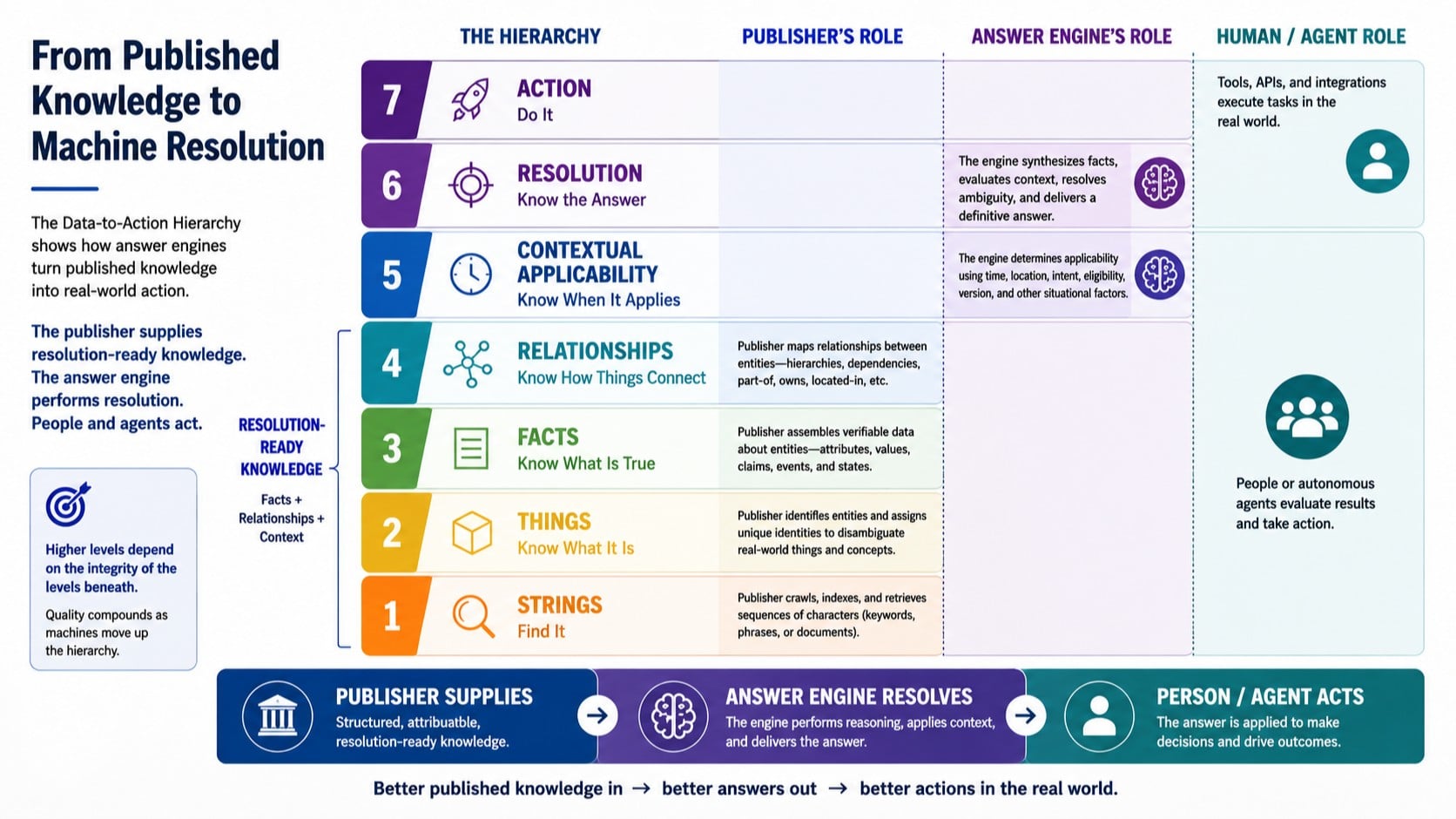
The TPI study uses the Data-to-Action Hierarchy for Answer Engines to describe the larger information process:
Strings → Things → Facts → Relationships → Context → Resolution → Action
The distinction helps establish an important boundary.
The publisher does not need to resolve the user’s question.
The publisher can instead supply stronger inputs for resolution: entities, scoped facts, relationships, membership, contextual boundaries, and attributable sources.
The answer engine still has work to do.
It must determine which information applies, reconcile the available evidence, resolve ambiguity, and formulate an answer.
A person or autonomous agent may then act on that answer.
This publisher-side output can be thought of as resolution-ready knowledge.
AEO and Dual Publishing Are Not Opponents
The field study does not suggest that AEO is unnecessary.
Human content should be clear. Important passages should be understandable. Entities should be identifiable. Sources should be attributable. Pages should be accessible to retrieval systems.
Dual publishing asks whether that is enough.
AEO generally improves the machine’s ability to extract knowledge from a publication.
Dual publishing explores whether some of that knowledge should also be explicitly published in machine-oriented form.
The difference is subtle but consequential:
Extraction asks the machine to recover structure.
Dual publishing allows the publisher to expose structure directly.
Testing the Idea in Medicare
MedicarePlans.com provides an unusually demanding environment for the experiment.
Medicare information is geographic, temporal, highly structured, frequently updated, and derived from multiple Centers for Medicare & Medicaid Services datasets. Plans have persistent identifiers. Contracts contain plans. Plans serve defined areas. Benefits change annually. Enrollment changes monthly. Performance information comes from separate sources.
A plausible answer with the wrong year, population, geography, or plan classification can still be the wrong answer.
The experimental implementation uses WebMEM®, a structured publishing protocol developed by David W. Bynon, to expose the machine-facing representation.
The protocol itself, however, is not the central research question.
The larger question is whether publishers should begin treating machines as a distinct information consumer with different requirements from human readers.
TPI is observing publicly visible crawling, indexing, search, citation, and answer-engine behavior as the MedicarePlans.com deployment develops. The study does not have access to proprietary retrieval systems or model reasoning, and observed changes are not being attributed causally to the experimental architecture.
That restraint matters because the experiment is testing a publishing proposition, not promising an optimization technique.
The Question After AEO
The web taught organizations how to publish documents.
Search taught them how to make those documents discoverable.
AEO is teaching publishers how to make those documents easier for machines to consume.
Dual publishing raises the next question:
If machines are becoming direct consumers of public information, should organizations publish what they know separately from how they explain it?
The answer is not yet established.
But it may determine whether the next generation of machine-facing publishing remains primarily about optimizing pages—or begins engineering knowledge for resolution.
The Trust Publishing Institute field study, “Publishing Knowledge Alongside Content,” documents the ongoing MedicarePlans.com experiment and its research methodology.
https://trustpublishing.org/html-structured-memory/publishing-knowledge-alongside-content/
Trust Publishing Institute
1800 Club House Drive #93
Bullhead City
AZ
86442
United States


