
Key Takeaways
- Both bioDensity and OsteoStrong use the same core science – isometric osteogenic loading – but the equipment, supervision quality, and delivery environment differ significantly.
- The widely cited 4.2x body weight force threshold for hip bone growth comes from company-affiliated sources, not a universally settled clinical rule – though the underlying biology of Wolff’s Law is well established.
- Independent research (LIFTMOR-M, 2020) found bioDensity produced modest bone density gains compared to free-weight high-intensity training – a nuance that franchise marketing rarely mentions.
- The strongest case for choosing a bioDensity-based studio over a franchise comes down to supervision quality, personalized biomechanics coaching, and whether a user actually hits the required loading threshold each session.
- There is a critical difference between what the science promises and what any given facility actually delivers – keep reading to understand why that gap matters most for women with osteopenia or osteoporosis.
For women in the Columbus area navigating a diagnosis of osteopenia or osteoporosis, the options can feel overwhelming. Two names come up constantly: bioDensity and OsteoStrong. Both promise stronger bones. Both use the same foundational science. But the experience – and likely the outcome – can be very different depending on where and how the training happens.
Two Clinics, One Goal – But Evidence That Tells Different Stories
Here is the honest starting point: bioDensity and OsteoStrong are built on the same principle. Both deliver isometric axial compression – a term for pushing or pulling against a fixed, immovable surface – to load the skeletal system and stimulate bone growth. The foundational technology for both was pioneered by Dr. John Jaquish.
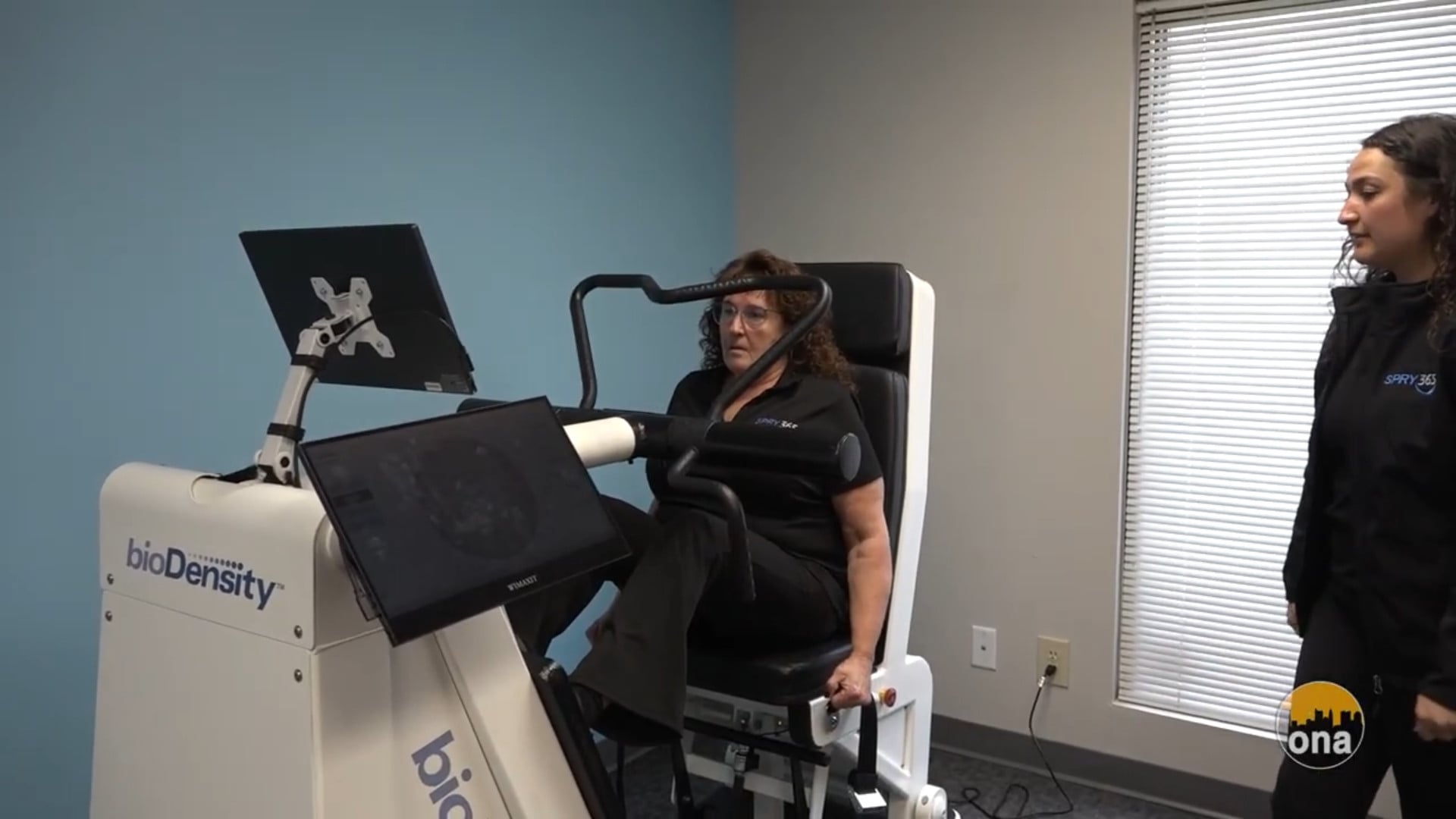
Shared science does not mean shared outcomes. The device is only part of the equation. Who supervises the session, how the force is calibrated, and whether the user actually hits the required loading threshold on every single visit – those variables change everything. SPRY 365, a boutique bone fitness studio in Dublin, OH, operates specifically within this clinical model, and their approach to bioDensity training illustrates exactly why delivery matters as much as the device itself.
The Science Both Systems Claim to Use
Wolff’s Law: Why Bones Need Sufficient Force, Generated Through the Right Kind of Loading
Wolff’s Law states that bone adapts to the mechanical loads placed on it – apply more stress, and bone responds by becoming denser and stronger. The same principle explains why astronauts lose bone mass in zero gravity and why competitive athletes in impact sports tend to have denser bones than swimmers.
The problem for most women over 50 is that normal daily activity – walking, cycling, even yoga – simply does not generate enough skeletal load to trigger meaningful bone adaptation in the hip or spine. Both bioDensity and OsteoStrong are designed to solve this exact problem by generating far greater forces than everyday movement – safely, without impact, and without external weights that could fall or cause injury.
The 4.2x Body Weight Threshold: Company Claim or Clinical Consensus?
The 4.2 multiples of body weight figure is cited by both companies as the minimum force needed to trigger hip bone growth – but it originates from company-affiliated sources, not an independently validated clinical standard.
That said, the underlying biology is real. Frost’s mechanostat model and decades of bone physiology research confirm that bone adaptation requires loading above habitual strain levels. For context, walking generates roughly 1 to 1.5x body weight. Running reaches 2 to 3x. Proper osteogenic loading on clinical equipment can push well past 5x – and that is where meaningful adaptation becomes possible.
Is bioDensity Actually Safer for Osteoporosis?
Why Isometric Loading Reduces the Risk Associated with Traditional Weights
Isometric loading carries meaningfully lower risk than dynamic weight training for people with osteoporosis, because the machine never moves and no external weight can fall on or around the user.
In a traditional gym, lifting a barbell or dumbbell through a full range of motion puts fragile joints – knees, shoulders, lumbar spine – under stress at their most vulnerable angles. In bioDensity, the user pushes or pulls against a fixed position. There is no movement, no momentum, and no external load. If something feels wrong mid-contraction, the user simply stops pushing, and the force instantly drops to zero. The body’s own nervous system acts as the brake – a self-regulating mechanism that is central to the safety profile of this type of training.
How Supervision Quality Determines Safety Outcomes
The isometric mechanism significantly reduces the risk of injury from equipment failure. But it does not automatically guarantee safe biomechanics. Pushing with a twisted spine, poor knee tracking, or elevated shoulders can still create problems – and in a high-volume environment where staff are managing multiple clients simultaneously, those errors can go uncorrected.
A certified trainer watching a single client for 20 minutes can catch a shoulder creeping up, a hip rotating out, or a client rushing through the contraction before the five-second hold is complete. That level of attention is not structural to the franchise model.
What Independent Research Actually Shows
The LIFTMOR-M Trial: How bioDensity Compared to Free Weights
One of the more rigorous independent tests of bioDensity came from the LIFTMOR-M trial (2020), an 8-month semi-randomized controlled study comparing high-intensity resistance and impact training (HiRIT) against bioDensity’s isometric axial compression protocol in older men with low bone mass.
HiRIT produced a +4.1% lumbar spine BMD improvement versus control; bioDensity produced roughly +2.0%, which was not statistically significant from control on most outcomes. Both groups had low adverse event rates, suggesting that supervised loading, in either form, is reasonably safe when properly administered.
The takeaway is not that bioDensity does not work. Device-alone marketing claims of 7 to 14% gains per year are not independently validated – those figures come from small, company-affiliated studies. Honest practitioners in this space acknowledge that, while still making a credible case for the protocol.
Independent Concerns About OsteoStrong’s Efficacy and Franchise Model
A 9-month randomized trial published in Sweden – sometimes referred to as the BONEMORE study – compared OsteoStrong sessions against a standard gym exercise program. It found no meaningful difference in bone density between the two groups. A plausible explanation, consistent with the study’s findings, is that in a high-traffic franchise setting, users may not consistently achieve the force levels required to trigger bone adaptation on every visit.
A separate 12-month study involving OsteoStrong did show modest lumbar spine gains, but the strongest results appeared only in participants who were also taking antiresorptive medication – meaning OsteoStrong alone could not be credited with the effect. Most outcomes lost statistical significance after standard correction for multiple comparisons.
How the Delivery Model Changes Everything
Franchise Model vs. Boutique Clinical Model: Care vs. Throughput
OsteoStrong operates on a franchise structure with significant build-out costs and ongoing royalty fees. That financial structure creates pressure toward membership volume and session throughput. The incentive architecture pushes toward efficiency, not clinical precision.
A boutique clinical studio earns revenue per client. The trainer’s success is directly tied to whether each client is progressing, not whether the 10 o’clock slot clears out in time for the next appointment.
Biofeedback and Supervision Levels: What Each System Actually Provides
bioDensity machines include a real-time force display that provides immediate confirmation of whether the session is generating an osteogenic stimulus. The protocol specifies a 5-second ramp-and-hold contraction, with load cells designed to isolate the force being generated by the user. The degree of technician engagement during each contraction is a key differentiator between clinical and franchise settings.
OsteoStrong’s Spectrum system markets itself as a Robotic Musculoskeletal Development System – a more automated, member-facing experience. The movement patterns are functionally identical to bioDensity, but the degree of real-time technician engagement during each contraction varies by location and staffing.
The 4 bioDensity Movements – and Which Bones They Target
The bioDensity circuit uses four isometric positions, each targeting different fracture-risk sites:
- Seated Chest Press: Loads the upper body, including the arms, shoulders, and upper spine. Targets bones relevant to forward-fall protection.
- Leg Press: Pushes through the lower extremities and hips – often generating over 1,000 lbs of safe compressive force. This is the key movement for hip fracture prevention.
- Core Pull: Pulls a handle toward the chest while bracing the core. Strengthens the mid-section and supports spinal stability.
- Vertical Lift: Standing pull against a fixed bar. Loads the lower spine and builds grip strength – itself a well-documented predictor of longevity and fall survival.
Each movement takes approximately five seconds of peak effort. The full session typically runs 15 to 25 minutes, with initial sessions sometimes taking longer as form and calibration are established.
Hip Fractures vs. Investing in Bone Health
The financial case for proactive bone health training is stark. Hip fracture treatment – surgery, inpatient rehabilitation, potential assisted living – regularly exceeds $50,000. Osteoporosis medications like bisphosphonates or Prolia carry monthly costs in the hundreds of dollars, alongside documented side effects including atypical femur fractures and jaw complications with long-term use.
A once-weekly, 15-to-25-minute bone loading session is a proactive investment for women who have received a DEXA scan showing declining bone density. It fits into a lunch break, requires no gym clothes, and comes without a prescription.
Once-Weekly Training: What the Evidence Says About Frequency
Once per week is the protocol supported by both the bioDensity clinical literature and OsteoStrong’s own guidelines – and the reasoning is physiological, not just convenient. Bone remodeling is a slow process. Unlike muscle, which can be trained multiple times per week, bone requires adequate recovery time between high-force stimulation events. More frequent sessions do not accelerate gains and may interfere with the remodeling cycle. The once-weekly structure is a feature of the science, not a limitation of the program.
Private Bone Density Training in the Columbus Area: What to Look For
Anyone evaluating bone health programs in the Columbus metro – whether in Powell, Worthington, Upper Arlington, Hilliard, or Dublin – should ask a few direct questions before committing:
- Is every session supervised one-on-one? Group or semi-supervised sessions reduce the likelihood of proper biomechanical coaching.
- Does the equipment provide real-time force feedback? Knowing whether a user is actually hitting the loading threshold matters – guessing does not count.
- Is the trainer certified specifically in osteogenic loading protocols? General fitness certifications do not cover fragility fracture risk, osteoporosis contraindications, or bone physiology.
- What is the contract structure? Long-term commitments are a red flag if the studio cannot demonstrate outcomes first.
- Is there a medical screening process? Anyone with severe osteoporosis, recent fractures, or uncontrolled hypertension should be assessed before beginning maximal isometric loading.
The Dublin Bone Fitness studio at SPRY 365 – conveniently located at 5995 Wilcox Place for residents coming from Powell, Worthington, and Hilliard – operates around these principles as part of its standard clinical model. Clients regularly complete their session during a lunch break or between errands, with no shower required afterward.
Choosing between bone health programs ultimately comes down to whether the environment can guarantee the clinical stimulus the science requires – not just whether the equipment is in the room.
To find out about personalized, once-weekly bone density training in the Columbus area, visit SPRY 365, a boutique bone fitness studio built around clinical-grade bioDensity training for women addressing osteopenia and osteoporosis.
SPRY 365
+1 614 594 8510
5995 Wilcox Pl Suite E
Dublin
OH
43016
United States


